Losing a tooth can affect much more than your smile. A missing tooth can make chewing difficult, affect your bite, and sometimes allow surrounding teeth to shift into the empty space. Fortunately, modern dentistry offers several effective ways to replace missing teeth, with dental implants and dental bridges being two of the most common options.
But which is better: a dental implant or a dental bridge?
The answer depends on factors such as your oral health, jawbone condition, number of missing teeth, budget, treatment timeline, and long-term goals.
In this guide, we compare dental implants vs dental bridges, including their procedures, benefits, drawbacks, durability, maintenance, and cost considerations, so you can understand which option may be right for you.
What Is a Dental Implant?
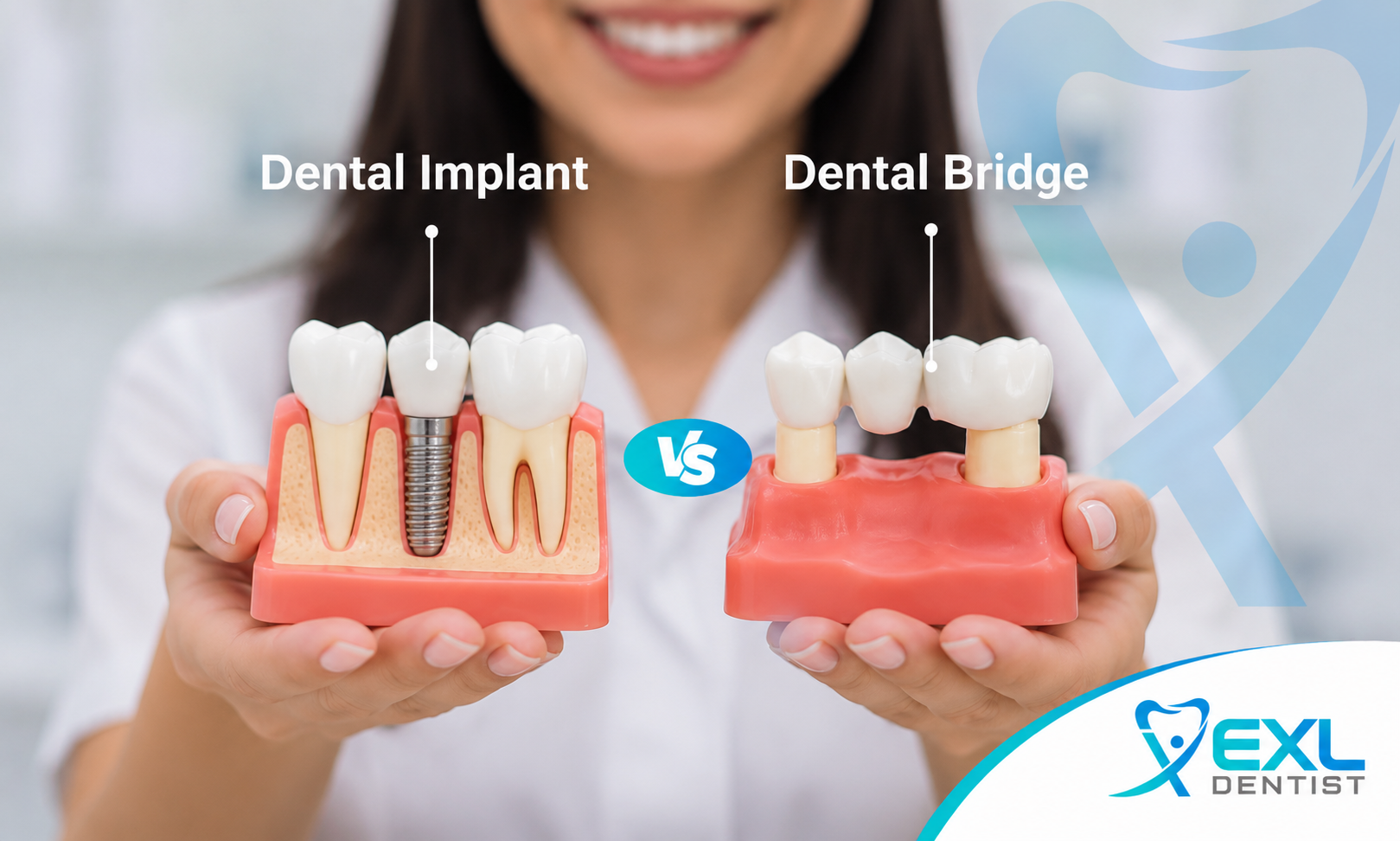
A dental implant is a tooth replacement solution designed to replace the missing tooth from the root upward. It typically consists of a titanium implant post, an abutment, and a dental crown.
The implant post is placed into the jawbone, where it can integrate with the surrounding bone. After healing, an abutment and customized crown are attached to restore the appearance and function of the missing tooth.
How Does a Dental Implant Work?
A typical dental implant treatment involves several stages:
- Dental examination and imaging
- Treatment planning
- Placement of the dental implant
- Healing and integration with the jawbone
- Placement of the abutment
- Attachment of the customized dental crown
The exact treatment timeline varies from patient to patient.
Benefits of Dental Implants
Dental implants offer several advantages:
- Replace the missing tooth without relying on neighboring teeth
- Provide a stable foundation for a dental crown
- Can look and feel similar to a natural tooth
- Help maintain stimulation of the jawbone
- Can be a long-term tooth replacement option with proper care
- Allow comfortable chewing and speaking
However, implants require adequate bone support and may involve a longer treatment process than a conventional bridge.
What Is a Dental Bridge?
A dental bridge replaces one or more missing teeth by placing an artificial tooth, called a pontic, between supporting teeth.
In a traditional dental bridge, the neighboring teeth are prepared to support dental crowns that hold the artificial tooth in place.
Unlike a dental implant, a traditional bridge does not replace the missing tooth root.
How Does a Dental Bridge Work?
The process generally involves:
- Examination and treatment planning
- Preparation of the supporting teeth
- Taking dental impressions or digital scans
- Fabrication of the customized bridge
- Placement and adjustment of the bridge
Depending on the type of bridge and individual case, treatment can often be completed more quickly than implant treatment.
Benefits of Dental Bridges
Dental bridges may offer:
- Faster tooth replacement in many cases
- No surgical implant placement
- Restoration of chewing function
- Improvement in the appearance of the smile
- A potentially lower initial treatment cost than an implant in some cases
However, traditional bridges require support from neighboring teeth, which is an important consideration when choosing between a bridge and an implant.
Dental Implant vs Dental Bridge: Key Differences
The main difference between a dental implant and a dental bridge is how the missing tooth is supported.
A dental implant replaces the tooth root, while a traditional dental bridge relies on neighboring teeth for support.
| Feature | Dental Implant | Dental Bridge |
| Tooth root replacement | Yes | No |
| Support | Jawbone | Neighboring teeth |
| Treatment time | Usually longer | Usually shorter |
| Surgery | Usually required | Usually not required |
| Effect on neighboring teeth | Usually does not require preparation | May require preparation |
| Bone preservation | Helps maintain bone stimulation | Does not replace the root |
| Appearance | Natural-looking | Natural-looking |
| Maintenance | Similar to natural teeth with proper care | Requires careful cleaning around and under bridge |
| Longevity | Can be long-lasting with proper care | Often needs replacement over time |
| Initial cost | Usually higher | Often lower initially |
The best choice depends on your individual dental condition rather than one treatment being universally better.
Dental Implant vs Bridge: Which Looks More Natural?
Both dental implants and bridges can provide an attractive and natural-looking smile when properly planned and fabricated.
A dental implant-supported crown can closely resemble a natural tooth because it is independently supported and designed to emerge from the gum area.
A dental bridge can also provide excellent cosmetic results, particularly when the bridge is made from high-quality dental materials and properly matched to your surrounding teeth.
Your dentist can recommend the appropriate option based on the location of the missing tooth, your bite, gum health, and aesthetic requirements.
Dental Implant vs Bridge: Which Is More Durable?
Durability is another important consideration when comparing a dental implant vs dental bridge.
Dental implants are designed as a long-term tooth replacement solution. With good oral hygiene, regular dental checkups, and appropriate care, an implant can provide many years of service.
Dental bridges can also be durable, but they may eventually require replacement due to wear, damage, changes in the supporting teeth, or gum-related problems.
The actual lifespan of either treatment depends on factors such as:
- Oral hygiene
- Gum health
- Bite forces
- Teeth grinding
- Diet and lifestyle
- Quality of dental treatment
- Regular dental checkups
Dental Implant vs Bridge: What About the Cost?
One of the most common questions patients ask is:
“Is a dental implant more expensive than a bridge?”
In many cases, the initial cost of a dental implant can be higher than a conventional dental bridge. However, comparing only the initial price may not provide the complete picture.
The overall cost can depend on:
- Number of missing teeth
- Type of implant
- Crown material
- Type of bridge
- Diagnostic tests and scans
- Bone grafting requirements
- Gum treatment
- Complexity of the case
- Dentist and clinic
- Additional procedures required
Therefore, it is better to have a dental examination and personalized treatment plan before comparing the final cost.
Dental Implant vs Bridge: Which Is Better for One Missing Tooth?
For a single missing tooth, both options can be effective.
A dental implant can replace the missing tooth while keeping the neighboring teeth independent. A traditional bridge, on the other hand, uses adjacent teeth to support the replacement tooth.
For patients with healthy neighboring teeth and sufficient bone support, an implant may be an attractive long-term option.
However, an implant may not be suitable for everyone. Your dentist needs to evaluate your jawbone, gums, overall oral health, and other factors before recommending treatment.
When Might a Dental Bridge Be a Better Option?
A dental bridge may be considered when:
- You want a relatively faster tooth replacement option
- Neighboring teeth can adequately support the bridge
- You are not a suitable candidate for implant surgery
- You prefer to avoid implant placement
- Your dentist determines that a bridge is appropriate for your specific situation
A bridge can be a practical solution for restoring function and appearance when properly planned.
When Might a Dental Implant Be a Better Option?
Dental implants may be considered when:
- You have sufficient jawbone support
- Your gums are healthy or can be treated
- You want an independent replacement for a missing tooth
- You want to avoid preparing healthy neighboring teeth for a traditional bridge
- You are looking for a long-term tooth replacement solution
However, suitability must be determined by a qualified dentist following an examination and appropriate imaging.
Dental Implant vs Bridge: Pros and Cons
Dental Implant Pros
- Replaces the missing tooth root
- Does not normally require preparation of adjacent healthy teeth
- Provides a stable foundation for a crown
- Can provide a natural appearance
- Helps maintain jawbone stimulation
- Can be a long-term solution
Dental Implant Cons
- Usually costs more initially
- Treatment can take longer
- Requires a surgical procedure
- Adequate bone and gum health are important
- Additional procedures may sometimes be necessary
Dental Bridge Pros
- Can often be completed faster
- Does not usually require implant surgery
- Restores chewing and appearance
- Can be an effective solution for missing teeth
- May have a lower initial cost
Dental Bridge Cons
- Traditional bridges rely on neighboring teeth
- Supporting teeth may need preparation
- Cleaning underneath the bridge requires additional care
- May eventually need replacement
- Does not replace the missing tooth root
Can You Replace a Dental Bridge With an Implant Later?
In some situations, a dental bridge can be replaced with a dental implant. However, the possibility depends on your current oral health, bone condition, gum health, and the condition of the surrounding teeth.
If you currently have a bridge and are considering switching to implants, your dentist can evaluate the area using a clinical examination and appropriate imaging.
Do not remove or replace an existing bridge without professional evaluation.
How to Choose Between a Dental Implant and Bridge
Choosing between a dental implant and bridge should not be based solely on cost.
Your dentist may consider:
1. Bone Health
Dental implants require adequate bone support. If there has been significant bone loss, additional treatment may sometimes be required.
2. Gum Health
Healthy gums are important for successful tooth replacement. Existing gum problems may need to be treated before certain restorative procedures.
3. Condition of Neighboring Teeth
If the teeth next to the missing tooth are already heavily restored or require crowns, a bridge may be considered.
If the neighboring teeth are healthy, an implant may allow them to remain independent.
4. Treatment Timeline
If you need a faster restoration, a bridge may sometimes be completed sooner than an implant.
5. Long-Term Goals
If you are looking for a long-term tooth replacement option and are a suitable candidate, your dentist may recommend an implant.
Dental Implant vs Bridge: Which Is Better?
There is no single answer to “dental implant vs bridge—which is better?”
For many suitable candidates, dental implants offer significant long-term advantages because they replace the missing tooth without relying on neighboring teeth and provide a foundation for an individual crown.
However, dental bridges can also be an effective treatment option, particularly when implant treatment is not suitable or when a patient prefers a faster, non-implant approach.
The right choice depends on your individual dental condition, goals, budget, and treatment needs.
A professional dental examination is the best way to determine which option is appropriate for you.
Frequently Asked Questions
Is a dental implant better than a bridge?
A dental implant may offer advantages such as independent support and replacement of the tooth root, but a bridge can be an effective alternative in appropriate cases. Your dentist can recommend the best option based on your oral health and treatment goals.
Which lasts longer, a dental implant or a bridge?
Dental implants can be a long-lasting tooth replacement option when properly maintained. Bridges can also last for many years, but their longevity depends on the condition of the supporting teeth, oral hygiene, bite, and other factors.
Is a dental bridge cheaper than an implant?
A traditional bridge often has a lower initial cost than a dental implant. However, the total treatment cost varies according to the patient’s condition, materials, number of teeth involved, and additional procedures required.
Is getting a dental implant painful?
Dental implant placement is performed using local anesthesia, so you should not feel the procedure itself in the way you might expect. Some discomfort or swelling can occur during the healing period.
Can a dental implant look like a natural tooth?
Yes. A customized implant-supported crown can be designed to closely match the color, shape, and appearance of your natural teeth.
Can I get an implant if I have bone loss?
Some patients with bone loss may still be candidates for implants after additional treatment, such as bone augmentation, when appropriate. A dental examination and imaging are necessary to determine suitability.
What is better for one missing tooth: an implant or bridge?
Both can work. An implant can replace the missing tooth independently, while a traditional bridge uses neighboring teeth for support. Your dentist can help determine which option is more appropriate for your situation.
How do I know whether I need an implant or bridge?
The best way to find out is to have your teeth, gums, bite, and jawbone evaluated by a dentist. Your dentist can then explain the available treatment options and their advantages and limitations.
Restore Your Missing Tooth at EXL Dentists Gurgaon
If you have a missing tooth and are unsure whether a dental implant or dental bridge is right for you, a professional dental evaluation can help you make an informed decision.
At EXL Dentists Gurgaon, patients can discuss their tooth replacement options with a dental professional and understand the treatment approach based on their individual needs.
Whether you are considering dental implants in Gurgaon, a dental bridge, or another tooth replacement option, getting a personalized assessment is an important first step.